Measured precision and recall
Every quantitative claim about the verifier on this page is tied to a specific validation run. The fixture is hand-curated, immutable, and published below as evidence. The results JSON files are timestamped receipts - you can inspect them, re-run the harness, and check our numbers against your own.
Latest blind holdout (n = 1,402) - the headline measurement
The current primary evidence is a blind holdout of 1,402 freshly-drawn citations- 1,152 correctly-cited (“clean”) and 250 fabricated or wrong - across the seven scoreable identifier types. Drawn on 2026-08-01 from a recorded seed, constructed title-independently (title similarity is the axis being measured, so selecting on it would be circular), human spot-checked (100 of 100 sampled entries confirmed fair, zero construction defects), sealed, and measured exactly once on 2026-08-02. A machine check confirms zero overlap (0 of 1,849 prior entries) with any set the verifier was previously tuned or measured against - including the 299-citation set the author fixes below were developed on. Every request returned HTTP 200, so every failure is a genuine verdict disagreement rather than a transport error.
Why this round exists. Between the previous holdout and this one we made five fixes to how author names are compared (see the changelog). Four make the comparison more permissive; the fifth goes the other way. Those fixes were checked against 299 correctly-cited papers with compound surnames, but that set contains no fabrications, so it could not show whether the added permissiveness let anything through. This round answers that, and its clean arm is deliberately harder: claimed author strings now come from citing bibliographies’ own author-typed LaTeX rather than pre-normalised registry fields, which is what real reference lists actually contain.
Did it wrongly flag a correctly-cited paper? Across the 1,152 clean citations: high-confidence false-accusations were 10 = 0.87%(Wilson 95% CI 0.47-1.59%, under our pre-registered 3% bar); including the low-confidence “needs-a-second-look” bucket, 1.22%. The comparable figure on the previous holdout was 2.70% - so the false-accusation rate fell by 55% (two-proportion z = 2.58, p = 0.0098). That is the result this round was built to test, and the one number here we would call a genuine improvement rather than a wash.
Did it still catch the fabrications? Yes - detection held rather than improved, which is the honest reading. On the five fabrication subtypes both rounds share, recall went from 82.7% (124/150) to 84.8% (140/165); that difference is not statistically significant (p = 0.60). Four of those five are perfect: real-DOI + fabricated title 35/35, wrong author 35/35, wrong DOI 35/35, PMID/DOI split 25/25. A citation counts as caught if the verdict is any non-matched value - mismatch, ambiguous, or not_found - because all three tell a reader to look again.
Overall fabrication recall this round is 87.3% (179/205), or 84.2% (181/215) including a shape we pre-registered as an expected failure (below). Do not read that against the previous round’s 85.6% as a decline. The corpora are not the same difficulty: this round dropped the easiest subtype (fully-invented titles, previously caught 100%) and added the hardest (a 50-citation near-miss author stratum built specifically to attack the new fixes). The shared-subtype comparison above is the only like-for-like one.
The new near-miss author stratum substitutes a different real person whose surname is deliberately similar - van der Berg → van der Meer, Kennicutt, Jr. → a different Kennicutt, Chen → Chan. Every surname on both sides is attested in a real bibliography; none is machine-mutated. Result: 41/50 - shared nobiliary particle 10/10, generational-suffix collision 10/10, one-letter short surname 10/10, relocated particle 9/10, one-letter long surname 2/10. That last is a pre-registered failure: we stated before measuring that a single character difference is arithmetically invisible from five characters up (worst-case similarity 0.920 against a 0.92 threshold), which is why we publish recall both with and without it.
A measured blind spot: near-miss semantic flips
The hardest attack class remains a real paper’s real title with a load-bearing word flipped to the opposite meaning (“Adults” → “Children,” “MALIGNANT” → “BENIGN,” “inhibitor” → “activator”). The verifier caught 10 / 35 - up from 4/30 last round, but still the weakest cell on this page. Worse than the miss rate: every one of the 25 misses was returned as matched at high confidence, and every one of the 10 catches was mismatch at low confidence. There is currently no setting at which this class is caught confidently.
We measured why, and the mechanism is arithmetic rather than semantic. Detection tracks the proportion of the title’s characters that changed, not the scientific importance of the changed word. Caught rows had a mean 12.1% of characters altered; missed rows 8.0% (on single-word flips, 9.1% vs 6.9%). By number of words flipped: one word 20% caught, two words 43%, three words 67%. Absolute length is only a proxy - a 142-character single-flip title was caught while 71-, 77- and 80-character ones were missed. MALIGNANT→BENIGN in a 107-character title is missed; Mouse→Human in a 50-character title is caught. Same clinical severity, opposite outcome, purely because of how much of the string moved.
This is not specific to our implementation. We scored the same missed pairs under four standard string metrics - Jaro-Winkler, normalised Levenshtein, Dice bigram, and token Jaccard. All four score the missed polarity flips between 0.87 and 0.98, at or above the thresholds such systems conventionally treat as a match, and all four agree the one row we did catch is the lowest-scoring. Lexical similarity metrics systematically dilute single-token polarity changes inside otherwise-matching titles. We think that is a blind spot for the whole family of similarity-based title matching - though to be clear, we have not tested competing tools on this attack, so we offer that as an argument about the metrics, not a measured claim about anyone else’s product.
The fix we are scoping, and the trap we are avoiding. The remedy is a deterministic polarity gate: where two titles are otherwise near-identical, detect that a meaning-flipping token was substituted and downgrade matched to ambiguous - a review prompt, never an automatic accusation. Forcing mismatch would push the false-accusation rate straight back up and undo the improvement above. It stays deterministic and explainable - a closed antonym lexicon, no model inference. The trap: the antonym list used to build this test set must not become the list used to implement the fix, or we would be marking our own homework. Any such gate has to be evaluated on fresh antonym pairs it has never seen.
Where the remaining false accusations are: books
The residual false-accusation rate is not evenly spread. Nine of the fourteen fall on the ISBN arm - 9 / 42 = 21.4% - against 0.33% for DOIs (3/900) and 0% for PMID, PMCID, and ADS bibcodes. Every one of the nine is the same book, flagged over cataloguing noise: an edition statement appended by the catalogue (The Norton Shakespeare vs The Norton Shakespeare, Based on the Oxford Edition, Second Edition, similarity 0.859), a dropped leading article (La Monadologie vs Monadologie, 0.823), a bundled-materials suffix, or a catalogue that has stripped accents into spaces (Mediterráneo → Mediterra neo, 0.914). Books are cited by work and catalogued by edition, and the two rarely agree on a title string.
Fixed on 2026-08-02, after the measurement (see the changelog). Title comparison now additionally tries three normalised forms: with a trailing edition/format statement removed, with a leading article in any of the catalogued languages removed, and with whitespace collapsed - which repairs a catalogue that has stripped an accent into a space. Each is applied additively, so a comparison can only score higher, never lower; re-checked against every fabrication in the sealed set, none became a match. Six of the nine now verify cleanly, which would put the ISBN arm near 7% rather than 21.4%.
⚠️ That 7% is a re-check of nine known cases, not a new measurement, and the 21.4% above stands as the sealed figure. We do not retro-fit numbers into a sealed run - the corrected rate has to come from the next blind holdout, drawn fresh and measured once, or it is just us marking our own homework on the cases we already knew about. Of the three that still flag, one turned out not to be a title problem at all: the catalogue record for that edition lists a co-author first, so the citation is being judged against a different author order. The other two are a catalogue that folds the author’s latinised name into the title field, and a bundled-materials suffix sitting just under the threshold. If you verify book citations, weight the 21.4% accordingly - it is the honest published figure, and the one we will re-measure against.
Previous blind holdout (n = 1,395) - the before-measurement
This was the headline until 2026-08-02, and it is what the round above is measured against: the 2.70% → 1.22% false-accusation comparison is this run versus that one. It was a blind holdout of 1,395 freshly-drawn citations - 1,185 correctly-cited and 210 fabricated or wrong - drawn on 2026-06-05 from a recorded seed, constructed title-independently, human spot-checked (105 of 105 confirmed fair), sealed, and measured exactly once, with zero overlap (0 of 855 prior entries) against any set the verifier had been tuned on. We additionally re-measured it a second time (99.9% verdict stability - the pipeline is deterministic) and ran the opt-in LLM screen over it.
Its numbers, unchanged. On the dominant fabrication patterns - real-DOI + fabricated title, wrong author, wrong DOI, PMID/DOI split, and fully invented - 150 / 150 = 100%, each subtype 30/30. Across the clean arm: high-confidence false-accusations 9 = 0.8% (Wilson 95% CI 0.4-1.4%); including the low-confidence bucket, 2.70%. The opt-in LLM screen cut the any-flag rate to 0.94% by rescuing 22 low-confidence cases, with zero cost to fabrication recall. Calibration was sound: ECE 0.026, high-confidence verdicts 97% correct.
Why its 85.6% recall is not comparable to the round above. That figure includes a fully-invented subtype (30 entries, caught 100%) which the 2026-08 round dropped as too easy, and excludes the 50-entry near-miss author stratum that round added as the hardest test we could build. Comparing the two aggregates would flatter this run and penalise the newer one for being harder. The like-for-like figure is the five subtypes both share: 82.7% then, 84.8% now.
Its two confident false-accusations, in full. Neither was a title-logic error. One was author-form handling - a DataCite literalauthor “de Azcarraga, Jose A.” compared against the cited “Azcarraga,” where the title matched exactly. One was an Open Library record that mis-titles a study guide as its parent textbook - a registry data-quality artifact, where the verifier correctly flagged that the cited title did not match the (mis-titled) resolved record. Both remain in the count; we do not adjust sealed numbers.
Earlier blind holdout (n = 350)
The earlier blind holdout - the lineage that got us here, kept in full for transparency - was 350 freshly-drawn citations (308 correctly-cited and 42 fabricated or wrong) spanning all eight identifier types. It was drawn on 2026-05-26 from a recorded random seed, constructed title-independently, human spot-checked (52 of 52 sampled entries confirmed fair), sealed, and then measured exactly once. A machine check confirmed it shared zero entries with any set the verifier was previously tuned or measured against.
Why measure blind. A number you can re-roll until it looks good is not evidence. The holdout is drawn after the code is frozen and measured a single time, so the result is committed before it is seen.
We found our own bugs - here is the loop. An earlier blind run, on a first holdout, measured a 5.3% false-accusation rate (95% CI 3.2-8.7%). Inspecting it showed the cause was not the title logic: it was (a) a bug in our own dataset construction(raw reference-list author strings stored in a mis-formatted way) and (b) two real gaps in the verifier - initials-first author names (“P Giral”) and a missing “Collaborators” group-author marker. We fixed all three (recorded in the changelog, 2026-05-26), then sourced a completely fresh, non-overlapping holdout - the one measured here - and ran it once: the false-accusation rate fell to 1.8% (CI 0.8-4.0%). We publish both runs in full - the first (discovery) holdout and its receipt are in Receipts below. Quietly discarding the first would have been the dishonest move; the discovery → fix → re-measure loop is the point. That loop continued into the n = 1,395 run, and then into the n = 1,402 run above: after this 350-entry holdout we fixed three further normalization known-hards (Greek-letter, numeric-HTML-entity, and Latin-extended title handling - changelog, 2026-06-05), then enlarged the holdout roughly 4x and re-drew it completely fresh. The larger sample tightened the intervals (the high-confidence false-accusation upper bound is now 1.4%, under our 3% bar) and surfaced a limitation the smaller set could not - the near-miss blind spot above.
Measured numbers (blind holdout, n = 350, pre-LLM)
Measured against the live production API on 2026-05-26, deterministic pre-LLM verdicts (the opt-in LLM screen was off). Every figure recomputes from the published receipt.
Did it catch the fabrications? Recall 37 / 37 = 100%(Wilson 95% CI 90.6-100%). Every fabricated and wrong-identifier subtype was flagged: real-DOI + fabricated title (16/16), wrong first author (6/6), wrong DOI (4/4), PMID/DOI split (4/4), fully invented (7/7). The interval’s lower bound, 90.6%, is the honest floor at this sample size.
Did it wrongly flag a correctly-cited paper? This false-accusation rate is the error that matters most. Pre-LLM, across the 285 clean reference-list citations that returned a verdict, 5 were flagged - 1.8% (Wilson 95% CI 0.8-4.0%). Every one of the five was low-confidence, and every one fell in a class already documented as hard:
- two translated titles (an English title cited against a French and a German original);
- one title carrying embedded markup in the registry record;
- one subtitle the citation kept but the registry stored separately;
- one likely online-first vs print year gap (title and author matched exactly).
There were no high-confidence false accusationsin this core arm - and that is what the confidence tier is for. Across the run, high-confidence verdicts were 98% correct, medium 100%, and low-confidence only 25%: the errors concentrate exactly where the verdict already says “low confidence,” which is the bucket the opt-in LLM screen is built to re-examine. So 1.8% pre-LLM is a conservative floor.
Two honest caveats. (1) 13 entries - the arXiv arm and one DOI - hit a transient production gateway error (HTTP 502) mid-run and returned no verdict; they are excluded from the counts above and will be re-measured (a slow upstream, not a verifier result). (2) The 4.0% interval upper bound reflects the sample size; the point estimate is 1.8%, and the with-screen rate is expected to be lower still, since the screen targets exactly the low-confidence mismatches above.
By identifier type (directional). Correctly-cited papers returned matched at: DOI 97.5%, PMID 100%, PMCID 100%, ADS bibcode 100%, ISBN 100%, WHO IRIS 9/10. Per-type counts are small (~12 each, by design), so read these as coverage confirmation, not per-type rates.
Validation set (v1, immutable)
Twenty hand-curated entries across five categories:
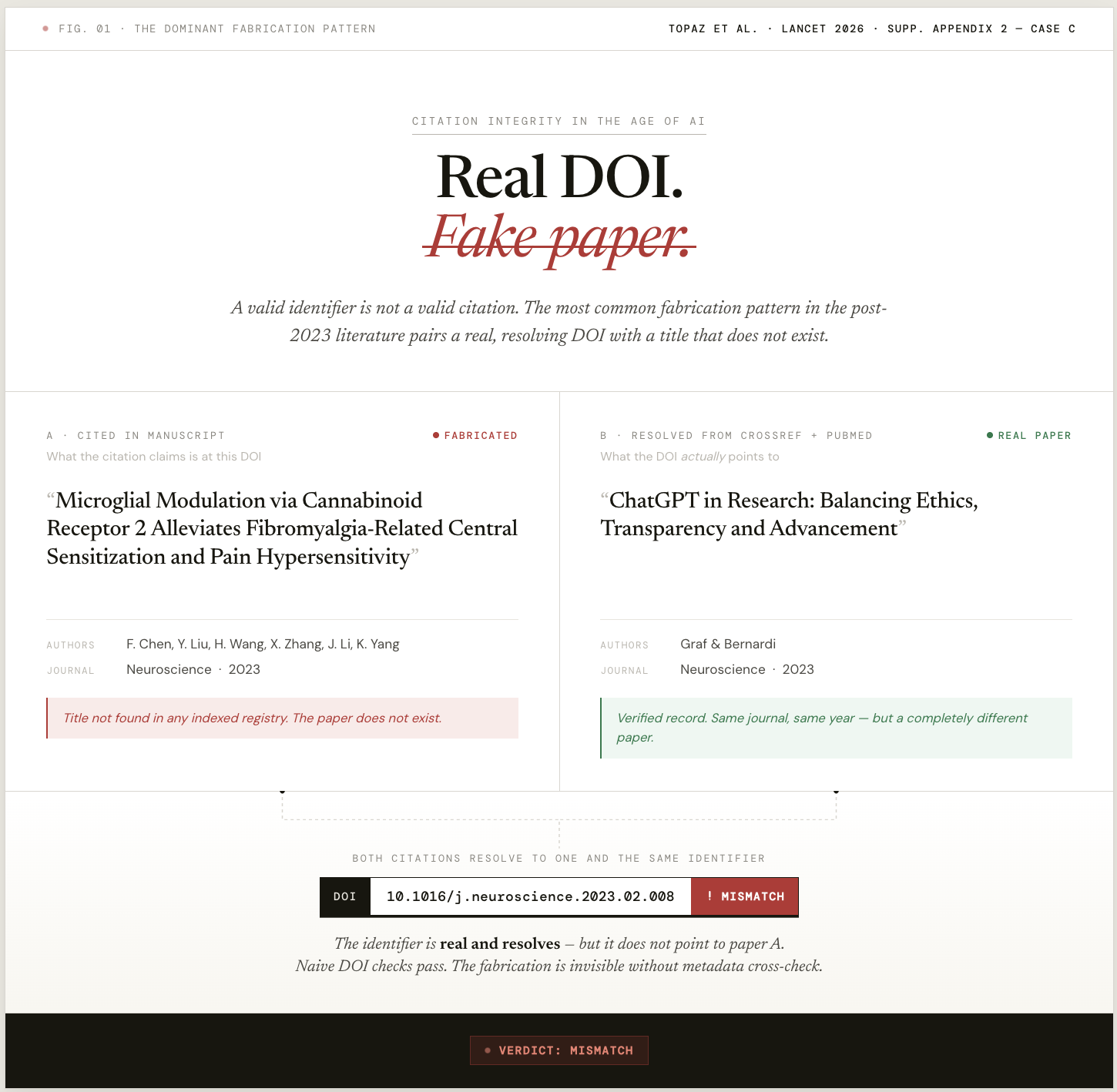
- 3 Lancet illustrative cases.Examples A, B, and C from Topaz et al.’s Supplementary Appendix 2, verbatim. Not our cases - the canonical fabricated-citation examples Topaz et al. chose to publish.
- 5 known-good citations. Real DOI or arXiv ID paired with the canonical title resolved via the scholar-sidekick MCP server. The verifier must return
matched. - 4 wrong-DOI cases (CITADEL “citation error” subtype). Real Paper X’s title paired with real Paper Y’s identifier. Both papers are independently verified; the swap is intentional. The verifier should detect the title mismatch and surface the actual paper as a candidate → verdict
ambiguous. - 4 paraphrase cases. Real DOI + paraphrased title designed to land in the LLM-screen-eligible bucket (mismatch with low confidence). The LLM screen should classify these as
informal_abbreviation and upgrade the verdict to matched. These four entries are the only ones we tuned against the live verifier - they were probed to ensure they exercise the LLM-screen path. The LLM’s verdict on them is what we report. - 4 invented cases. No real paper. Either an invented DOI, an invented title with no identifier, or an impossibly large PMID. The verifier should return
not_found.
Measured numbers (v1 fixture, n = 20)
All figures below are recomputed from the published receipts (downloadable in full below). Each receipt’s per-entry results array carries the verdict, confidence, and resolution source for every case, so the recall, false-accusation rate, and intervals here can be recomputed from the JSON alone - no access to our code required. Confidence intervals are Wilson 95% - wide on purpose, because the fixture is small and every entry is hand-verified.
Verdict conformance.Every one of the 20 entries returned its expected verdict, in both pre-LLM and with-LLM-screen modes. (The receipts’ own metricsblock records this as precision = recall = F1 = 1.000 on the harness’s expected-verdict basis. The figures below recompute ground-truth recall and false-accusation rate, with confidence intervals, so the sample size is visible rather than hidden.)
Did it catch the fabrications? 11 of 11 fabricated and wrong-identifier cases were flagged - recall 100%, 95% CI 74-100%. A perfect 11/11 still only proves recall is at least ~74% at this sample size.
Did it wrongly flag a real, correctly-cited paper? This false-accusation rate is the number that matters most - flagging a genuine citation is the dangerous error. Across the 9 clean citations:
- High-confidence false flags: 0 of 9 in both modes (95% CI 0-30%). The verifier never confidently accused a real citation.
- Including low-confidence flags: 4 of 9 pre-LLM (the paraphrase cases, which the simple verifier routes to the LLM screen by design), falling to 0 of 9 once the LLM screen is enabled.
The gap a plain DOI check leaves. Seven cases pair a real, resolving identifier with a title that does not match the paper it points to - the dominant Topaz pattern:
| Check | Real-DOI fabrications caught |
|---|
| Scholar Sidekick verifier | 7 / 7 (95% CI 65-100%) |
| Plain “does the identifier resolve?” | 0 / 7 |
A resolve-only check catches none of these by construction - the identifiers do resolve, just to the wrong paper. That gap is the entire reason a verifier exists.
Cost and latency. ~0.001 USD per applied LLM screen (4 of 20 entries triggered it); total run under half a cent. Per-request latency p50 ~ 2 s, p95 ~ 10 s (pre-LLM, point-in-time, measured over the network and including one rate-limit retry).
How to read this. A reproducible methodology check on hand-picked adversarial cases, not a 99-percent-style accuracy claim. The intervals are wide because n = 20 - the 1,402-entry blind holdout above is the larger clean arm that tightens the false-accusation-rate bound.
Receipts
Latest run (n = 1,402, measured 2026-08-02):
- validation-set-v5-blind.json - the sealed 1,402-entry blind holdout (seed, partitions, per-subtype attack types, disjointness check, and the full 100-row hand spot-check with every per-entry verdict)
- validation-results-v5-blind-pre-llm.json - the single measure-once receipt. Every headline number above recomputes from this file plus the sealed set, with no access to our code.
- validation-measurement-v5-blind.json - our own analysis of that receipt: every recall denominator, the v4-to-v5 comparison and its significance tests, the per-subtype breakdown, and all 35 near-miss-title rows with their word-flips, title lengths, and changed-character fractions. Includes the caveats we attach to our own numbers - notably that the ~9% changed-fraction threshold quoted above is fitted on the same 35 rows it describes, and is a descriptive mechanism rather than a validated classifier.
Previous run (n = 1,395, 2026-06-05) - superseded as the headline, kept as the before-measurement for the 2.70% → 1.22% comparison:
Earlier runs (kept in full for transparency - the discovery → fix → re-measure lineage):
The fixtures are marked immutable. Each new measurement gets its own versioned, immutable fixture; old numbers always cite the specific fixture version they came from.
The validation data is released under CC BY 4.0 - reuse it, including for independent replication, with attribution.